Below you will find pages that utilize the taxonomy term “Book Publishing”
New edition for the Rector Book

A couple of weeks ago, Tomas Votruba emailed me saying that he just realized that we hadn’t published an update of the book we wrote together since December 2021. The book I’m talking about is “Rector - The Power of Automated Refactoring”. Two years have passed since we published the current version. Of course, we’re all very busy, but no time for excuses - this is a book about keeping projects up-to-date with almost no effort… We are meant to set an example here!
My book-writing workflow
By request: what’s my workflow for writing books? Steps, tools, etc.
Writing with the Leanpub platform
A long time ago I noticed that testing-advocate Chris Hartjes published his books on Leanpub. When I had the idea of writing a book about the Symfony framework, I tried this platform and it was a good match. You can write your book in Markdown, commit the manuscript to a GitHub repository, and push the button to publish a new version. Leanpub will generate EPUB and PDF versions for you. Readers can be updated about releases via email or a notification on the website.
New book: Recipes for Decoupling
My new book Recipes for Decoupling is 100% complete and available now!
And now some other news related to this book.
A little background information
My new book is based on two things: 20 years of experience with (mostly framework) coupling issues in legacy code, and the hypothesis that PHPStan, the automated static analysis tool for PHP, can help us keep our code decoupled. Decoupling often means we want to use a dependency, but don’t want to couple our code too tightly to it. The process of decoupling often involves some kind of rule, like “don’t use Container::get()”, but we don’t want to focus on this rule all the time, or explain it to new members of the team. Instead, we want a tool that shows you an error when you don’t follow the rule. Such an error will break the build of the project and prevent you from ever coupling to a dependency in this specific way again.
Release of the Rector book
TLDR;
Rector - The Power of Automated Refactoring is now 100% completed
Tomas Votruba and I first met a couple of years ago at one of my favorite conferences; the Dutch PHP Conference in Amsterdam (so actually, we’re very close to our anniversary, Tomas!). He presented Rector there and it was really inspiring. A year later I was working on a legacy migration problem: our team wanted to migrate from Doctrine ORM to “ORM-less”, with handwritten mapping code, etc. I first tried Laminas Code, a code generation tool, but it lacked many features, and also the precision that I needed. Suddenly I recalled Rector, and decided to give it a try. After some experimenting, everything worked and I learned that this tool really is amazingly powerful!
Early release of Rector - The power of automated refactoring
In October 2020 I asked Tomáš Votruba, the mastermind behind Rector, if we could have a little chat about this tool. I wanted to learn more about it and had spent a couple of days experimenting with it. Tomáš answered all my questions, which was tremendously valuable to me personally. When this happens I normally feel the need to share: there should be some kind of artefact that can be published, so others can also learn about Rector and how to extend it based on your own refactoring needs.
Excerpt from PHP for the Web: Error handling
This is an excerpt from my book PHP for the Web. It’s a book for people who want to learn to build web applications with PHP. It doesn’t focus on PHP programming, but shows how PHP can be used to serve dynamic web pages. HTTP requests and responses, forms, cookies, and sessions. Use it all to build a CRUD interface and an authentication system for your very first web application.
Chapter 11: Error handling
Release of the Advanced Web Application Architecture book
100% done
I’m happy to announce that my latest book “Advanced Web Application Architecture” is now complete. With ~390 pages it has become a well-rounded book full of useful design patterns and architectural principles built around the notion of object-pure code, that will help you create decoupled applications that are testable by definition, and support a domain-first approach to software development.
Use this link to get 10% off the price: https://leanpub.com/web-application-architecture/c/RELEASE_DAY
Book release: PHP for the Web

While Advanced Web Application Architecture is still a work in progress, I decided to release another project in the meantime: a book for beginning PHP developers called PHP for the Web.
Of course, there are PHP books for beginners, but most of them aren’t very concise. They cover many related topics like relational databases, CLI applications, and sending emails. I wanted to write a book that only shows what makes PHP so special when it comes to web development.
Creating a simple link registry
The problem: if you publish any document as PDF, in print, etc. and the text contains URLs, there is a chance that one day those URLs won’t work anymore. There’s nothing to do about that, it happens.
Luckily, this is a solved problem. The solution is to link to a stable and trustworthy website, that is, one that you maintain and host (of course, you’re trustworthy!). Then in the document you link to that website, and the website redirects visitors to the actual location.
Early release of the Advanced Web Application Architecture book
In the Epilogue of the Object Design Style Guide, I started happily outlining some of the architectural patterns I’ve been using for several years now. I wanted to give some kind of an overview of how the overall design of your application would improve if you apply the object-design rules in that book. I soon realized that an Epilogue was not enough to cover all the details, or to communicate the ideas in such a way that they would be applicable in everyday projects. And so a new book project began…
The release of Object Design Style Guide

Today Manning released my latest book! It’s called “Object Design Style Guide”.
In November 2018 I started working on this book. The idea for it came from a conversation I had with the friendly folks at Akeneo (Nantes) earlier that year. It turned out that, after days of high level training on web application architecture and Domain-Driven Design, there was a need for some kind of manual for low level object-oriented programming. Not as low level as the kind of programming advice people usually refer to as clean code, but general programming rules for different kinds of objects. For instance:
Style Guide for Object Design: Release of the PHP edition
Please note: The Object Design Style Guide is now available via Manning,
With a foreword by Ross Tuck
Today I’ve released the revised edition of my latest book “Style Guide for Object Design”. Over the past few weeks I’ve fixed many issues, smaller and larger ones. Ross Tuck and Laura Cody have read the manuscript and provided me with excellent feedback, which has helped me a lot to get the book in a better shape. I added many sections, asides, and even an extra chapter, because some topics deserve more detail and background than just a few paragraphs. Oh, and Ross wrote the kindest of forewords to kick off the book. It’s available in the free sample of the book.
Principles of Package Design, 2nd edition
All of a sudden it became book-writing season. It began in August when I started revising my second book, “Principles of Package Design”. Apress had contacted me about adopting it, and they didn’t want to change a lot about it. However, the book was from 2015 and although I had aimed for it to be “timeless”, some parts needed an update. Furthermore, I had happily pressed the “Release” button back then, but it’s the same as with software development: the code you wrote last year, you wouldn’t approve of today.
Blogging every week
A very important “trick” in finding the flow in life is: do what you like most. Of course, you have to do things you don’t like (and then you need different life hacks), but when you can do something you like, you’ll find that you’ll be more successful at it.
When it comes to blogging, I find that it helps to follow my instincts, to write about whatever I like to write about at the moment. I can think of a list of things that need blogging about, but I end up not writing about them because they don’t light the fire inside me (anymore).
The release of "Microservices for everyone"
Today I’m happy to release my latest book, “Microservices for everyone”! 90% of it was done in July but you know what happens with almost-finished projects: they remain almost-finished for a long time. I did some useful things though, like preparing a print edition of the book.
Foreword
Finally, and I’m very proud of that, I received Vaughn Vernon’s foreword for this book. You may know Vaughn as the author of “Implementing Domain-Driven Design”. It made a lot of sense to ask him to write the foreword, since many of the ideas behind microservice architecture can be traced back to messaging and integration patterns, and Domain-Driven Design. Vaughn is an expert in all of these topics, and it was only to be expected of him to write an excellent foreword.
Preparing a Leanpub book for print-on-demand
During the last few days I’ve been finishing my latest book, Microservices for everyone. I’ve used the Leanpub self-publishing platform again. I wrote about the process before and still like it very much. Every now and then Leanpub adds a useful feature to their platform too, one of which is an export functionality for downloading a print-ready PDF.
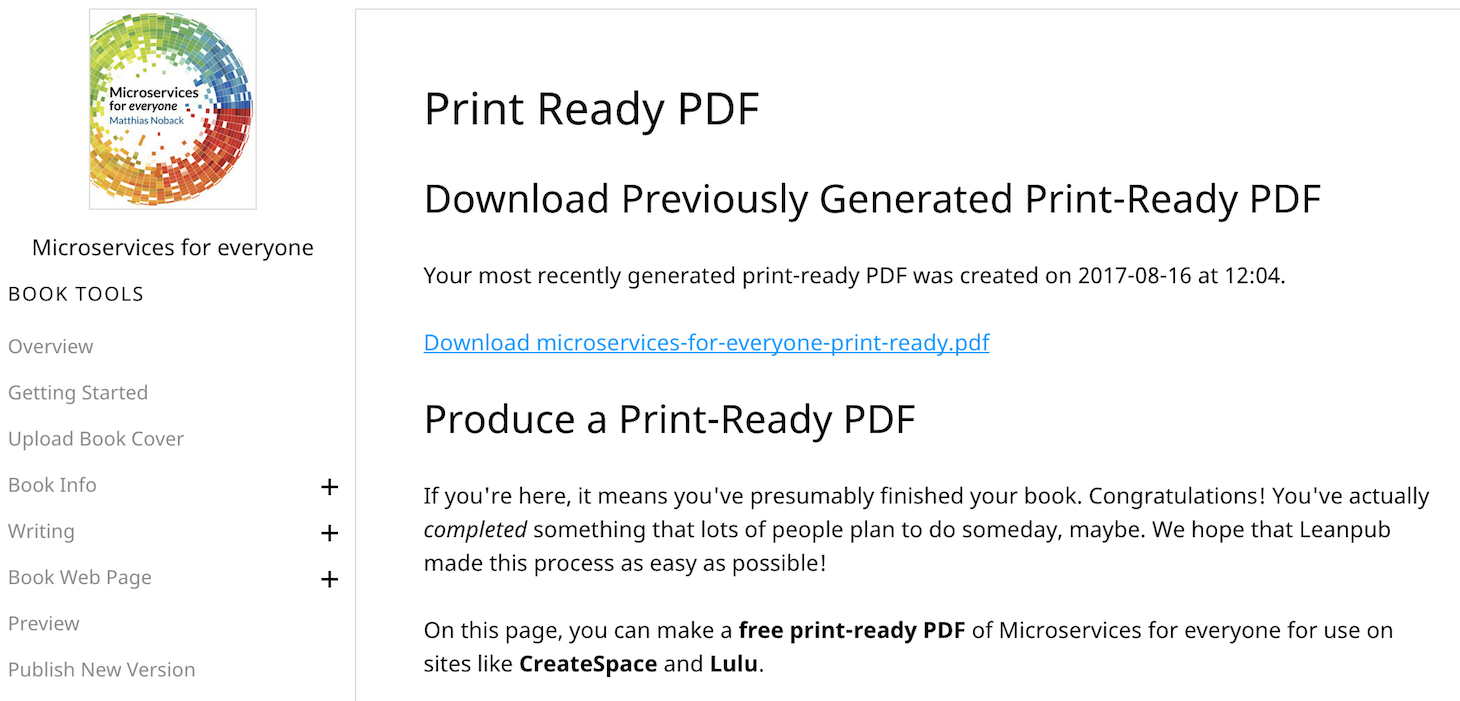
Previously I had to cut up the normal book PDF manually, so this tool saved me a lot of work. Though it’s a relatively smart tool, the resulting PDF isn’t completely print-ready for all circumstances (to be honest, that would be a bit too much to ask from any tool of course!). For example, I wanted to use this PDF file to publish the book using Amazon’s print-on-demand self-publishing service CreateSpace, but I also wanted to order some copies at a local print shop (preferably using the same source files). In this post I’d like to share some of the details of making the print-ready PDF even more print-ready, for whomever may be interested in this.
Microservices for everyone - The introduction
I’m happy to share with you the first chapter of my new book, Microservices for everyone. I’m still in the process of writing it and intend to release parts of it during the next weeks. If you’re interested, sign up on the book’s landing page and receive a 25% discount when the first chapter gets released.
If you’re curious about the table of contents so far: you’ll find it in the PDF version of the introduction.
A Year With Symfony - End Of Life
TLDR;
- I won’t update A Year With Symfony anymore.
- The e-book is now freely available.
My first book, A Year With Symfony, was well received when I first published it on September 4th. At the time it seemed to be a welcome addition to the official Symfony documentation.
A lot of water has passed under the bridge since then. Several new Symfony components were released and we have now arrived at the next major version, 3.0. In the meantime I published one update of the book: a new chapter about Annotations.
Lean publishing "Principles of Package Design"
During the great PHP Benelux Conference 2015 edition I published the final version of Principles of Package Design. Let me tell you a little bit about its history and some of the things I had to deal with.
A bit of history
My first book, A Year With Symfony, was released on September 4th, 2013. Just 6 days later, I started working on Principles of PHP Package Design. As it turned out, it was quite hard to keep the process going. There were several months in which I wrote nothing at all. Sometimes I picked up the work, but then I had completely lost my track and tried to get back on it by revising existing chapters over and over again. Meanwhile all kinds of other projects begged for attention as well, including the release of the backend project of the new nos.nl website, the preparations for the Hexagonal architecture training and the birth of our daughter Julia ;)
Announcements after a year with "A Year With Symfony"
As a follow-up on a previous article I have some announcements to make.
Feedback
A wonderful number of 67 of you have provided very valuable feedback about “A Year With Symfony” - you sure wrote some nice things about my book! Just a small selection of highlights:
Reading “A Year With Symfony” helped to clarify and validate the ideas and structures that I had been developing with my team, along with explaining some of the internals of Symfony that the documentation did not.
Celebrating a year with "A Year With Symfony"
Almost a year ago, on September 4th, in front of a live audience, I published my first book “A Year With Symfony”. Since the first release, well over a 1000 people have read it. In February of this year, I added a new chapter to the book (about annotations).
A third edition?
Flipping through the pages and thinking about how I could best celebrate 1 year and 1000+ readers, I had the following ideas:
Principles of PHP Package Design - First part of the book is now available
Seven months, two presentations and three blog posts later, I’ve published the first installment of my new book, Principles of PHP Package Design.
From the introduction of the book:
Naturally the biggest part of this book covers package design principles. But before we come to that, we first take a close look at what constitutes packages: classes and interfaces. The way you design them has great consequences for the characteristics of the package in which they will eventually reside. So before considering package design principles themselves, we first need to take a look at the principles that govern class design. These are the so-called SOLID principles. Each letter of this acronym stands for a different principle, each of which we will briefly (re)visit in the first part of this book.
There's no such thing as an optional dependency
On several occasions I have tried to explain my opinion about “optional dependencies” (also known as “suggested dependencies” or “dev requirements”) and I’m doing it again:
There’s no such thing as an optional dependency.
I’m talking about PHP packages here and specifically those defined by a composer.json file.
What is a dependency?
First let’s make sure we all agree about what a dependency is. Take a look at the following piece of code:
About coding dojos, the Symfony meetup and my new book
Last week was a particularly interesting week. I organised three coding dojos, on three different locations. The first one was at the IPPZ office (one of the companies I’ve worked for), the second one was at the SweetlakePHP meetup in Zoetermeer. The last one was for a group of developers from NOS, a large Dutch news organization. Although that would have been enough, I finished the week with my revised talk “Principles of PHP Package Design” at a meeting of the Dutch Symfony Usergroup in Utrecht…
A Year With Symfony: Bonus chapter is now available!
My first book, A Year With Symfony, has been available since September 4th last year. That’s not even six months ago, but right now it has almost 800 readers already (digital and printed edition combined).
During the past few days I’ve taken the time to write an extra chapter for the book. Consider it as a big thank you to everybody who bought the book! I feel very much supported by the Symfony/PHP community and this really keeps me going.
The "dark" side of PHP
About the nature of PHP and its misuse in package design
 This text will be part of the introduction of my upcoming book Principles of PHP Package Design. If you’d like to be notified when the book is released, you can subscribe on the book’s page. This will entitle you to a 20% discount once the book is available for download.
Before we continue with the “main matter” of this book, I’d like to introduce you to the mindset I had while writing it. This particular mindset amounts to having a constant awareness that PHP has somewhat of a dark side, as well as keeping our hopes high that it is very well possible to expose this “dark side” to a warm sun of programming principles, coding standards and generally good ideas, collected over the years, carefully nurtured and enhanced by great programmers of different languages and cultures.
Interview with Leanpub: A Year With Symfony
Last year in September Len Epp from Leanpub.com interviewed me about my book A Year With Symfony. They have fully transcribed the interview as well as published the recording of the interview.
This is the first time somebody interviewed me about my career and my book writing. I remember back then it made me quite nervous. But I must say that talking with Len was a very good way to shed some light on my own thought process and my personal goals. For instance, who did I have in mind as the reader of my book?
PHP - The Future of Packages
Recently I tweeted about phpclasses.org. It was not such a friendly statement:
Why does phpclasses.org still exist? Most of the “packages” contain dangerous, stupid or useless code.
Manuel Lemos, the man behind PHP Classes, made me pull back a bit by pointing out that I was generalizing and that they do what they can to encourage people to do a good job. I recognize their effort. And of course, there is also good code on phpclasses.org.
Looking back at the release of "A Year With Symfony"
A couple of weeks ago the reader count of my first book A Year With Symfony reached the number 365. It seemed to me an appropriate moment to write something about my experiences. In this post, I will not be too humble, and just cite some people who wrote some very nice things about my book on Twitter.
The book was highly anticipated ever since I first wrote something about it on Twitter. Leanpub book pages have a nice feature where users can subscribe to news about the book release.
Official book presentation: A Year With Symfony
After working on my book “A Year With Symfony” for four months, I published it yesterday at the Dutch Symfony Usergroup meetup in Amsterdam. It was really great to be able to do this real-time while everybody in the room was looking at the screen waiting for the build process to finish.
The book is hosted on Leanpub, which is a great platform for writing and publishing books. They provide the entire infrastructure. You get a good-looking landing page and they handle all things related to payment.
A New Book About Symfony2: A Year With Symfony
As you may have heard, I’m working on a book for Symfony2 developers. Besides The Book, which is the user documentation for building Symfony applications, some book-like websites and just a few e-books, there are currently no books for intermediate or advanced Symfony developers. My new book, called A Year With Symfony is exactly that.
If you have been reading the documentation and maybe some blog posts, you will want to know how you can get one step further. You wonder how you could structure your application, for it to be maintainable for more than a month. You ask yourself what it would take to write good bundles, which guidelines you and your team should define and follow. You may also question the built-in security measurements and you or your manager would like to know what needs to built on top of them to make a real secure application. A Year With Symfony will help you find an answer to all these questions.