Below you will find pages that utilize the taxonomy term “Community & Events”
Millennials doing things everyone should know about
Last year I had a video call with Tomas Votruba, creator of Rector, who kindly took the time to explain a lot of things about this project. We finished the call and I couldn’t wait to tell my partner how nice it was. I said to her: we should have recorded it, I’m sure it would be useful for other people too. She replied: this is so typical; millennials having a nice conversation and then they want to let the world know about it.
On using PSR abstractions
Several years ago, when the PHP-FIG (PHP Framework Interop Group) created its first PSRs (PHP Standard Recommendations) they started some big changes in the PHP ecosystem. The standard for class auto-loading was created to go hand-in-hand with the then new package manager Composer. PSRs for coding standards were defined, which I’m sure helped a lot of teams to leave coding standard discussions behind. The old tabs versus spaces debate was forever settled and the jokes about it now feel quite outdated.
Talk review: Thomas Pierrain at DDD Africa
As a rather unusual pastime for the Saturday night I attended the third Domain-Driven Design Africa online meetup. Thomas Pierrain a.k.a. use case driven spoke about his adaptation of Hexagonal architecture. “It’s not by the book,” as he said, but it solves a lot of the issues he encountered over the years. I’ll try to summarize his approach here, but I recommend watching the full talk as well.
Hexagonal architecture
Hexagonal architecture makes a distinction between the use cases of an application, and how they are connected to their surrounding infrastructure. Domain logic is represented by pure code (in the FP sense of the word), surrounded by a set of adapters that expose the use cases of the application to actual users and connect the application to databases, messages queues, and so on.
Newcrafts 2019 Day 1
This week I attended and spoke at the Newcrafts conference in Paris. The following is a mix of notes and personal observations I wanted to share, centered around some of the talks I saw there.
Romeu Romera: Bourdieu’s Social theory and our work in tech
I had never attended a talk by Romeu before. I really enjoyed this one. Somehow I already knew that he uses a mindmap to support his talk. I thought he would use an existing mind map to navigate through the talk, but it turned out he was creating one during the talk. For me personally, a slide deck helps to keep track of the story, and it helps me remember all the different topics I need to talk about. Not so much for Romeu, who knew exactly what he was going to talk about, and didn’t seem to forget to mention any important part, or make important connections.
DDD Europe notes - Day 2
Cyrille Martraire: Domain modeling towards First Principles
This was a talk from the first day, but it required some more processing before writing about it. Cyrille is one of my favorite speakers. He’s fast, funny and brings a lot of interesting topics to the table. So many that it’s sometimes hard to keep following his train of thought, and writing down some notes at the same time.
A central concept from his talk was what he called the waterline between IT and the business. In a traditional scenario, developers get provided with “work” on a case-by-case basis. They don’t learn about the general idea or plan, or even the vision, goal or need that’s behind the “work item”. They just have to “implement” it. It leads to badly designed code. But it also leads to the wrong solutions being delivered. If only developers could have talked with the people who actually have the problem for which they build the solution. Maybe there’s another problem behind it, or maybe the business has provided the developer with a solution, instead of a problem. To higher the waterline means to get more involved with the customers and users, to understand their problems, and work together on a solution. Make sure you get involved.
DDD Europe notes - Day 1
Eric Evans: Keynote (“Language in Context”)
Starting out with the basics (words have meaning within a context; when we make the boundary of this context explicit we end up with a bounded context), Eric discussed two main topics: the Big Ball of Mud, and bounded contexts in the context (no pun intended) of microservices.
Legacy applications are always framed in a negative way, as if it’s something to get away from. Personally, I’ve come to enjoy them a lot. However, there will always be the urge to work around legacy code. The Bubble Context (PDF) can be a great way of creating a new model that works well next to the already existing models. To keep a safe buffer between the new and the old model, you could build an Anti-Corruption Layer (ACL). A fun thing Eric mentioned is that the buffer works in two directions. The ACL also allows the old model to keep functioning without being disturbed by all the new things that are going on in the Bubble Context.
Call to conference organisers: pay your workshop instructors
A little background: speakers don’t get paid
Speakers like myself don’t get paid for doing a talk at a tech conference. That’s why I call this work “open source”. People will get a video or audio recording of the talk, including separately viewable or downloadable slides for free. The idea is, a conference costs a lot of money to organise. It is quite expensive to fly in all those speakers. So there’s no money to pay the speakers for all their work (for me personally it’s about 80 hours of preparation, plus time spent travelling, usually half a day before and after the conference). Speakers get their travel costs reimbursed, they often get two nights at a hotel, and a ticket to the conference. Plus, they get advertising for their personal brand (increasing their reputation as an expert, a funny person, or just a person with more Google results for their name).
Making money with open source, etc.
So, here’s a bit of a personal blog post for once.
Symfony trademark policy
I saw this tweet:
Suite à une mise en demeure, j’ai retiré les tutoriels qui concernent Symfony du Site. Il n’y aura pas de futures vidéos sur le Framework.
— Grafikart (@grafikart_fr) March 11, 2017
Meaning: “Following a formal notice, I removed the tutorials that are related to Symfony from the Site. There will be no future videos on the Framework.”
DDD Europe Conference Report - part III
In previous articles I’ve already spent a few words on some of the talks I watched at DDD Europe that made quite an impact on my thoughts about software development and design. The design part is often the most philosophical one. Design talks are often less practical. Speakers use metaphors to bring their message across and take note of other disciplines than software engineering to discover useful design principles and heuristics.
Rebecca Wirfs-Brock: Design Matters
The opening keynote of the second day was particularly philosophical. To be honest, I didn’t know Rebecca. She is co-author of several important books on object design: “Designing Object-Oriented Software” and “Object Design: Roles, Responsibilities, and Collaborations”. It should be interesting to take a look at these some time.
DDD Europe Conference Report - part II
In a previous post I discussed some of the talks I attended at the DDD Europe conference in Amsterdam. This conference has offered a lot more amazing content and I’d like to continue to tell you about it.
Lately I’ve been thinking about why Domain-Driven Design (DDD) has such a great attractive force on me. In particular when at the same time I’m strongly attracted by technology like Docker and its surrounding ecosystem of tools that are finally helping us to fulfill the ideal of continuous delivery, with relative ease. Configuring servers, deploying them, connecting them, etc. is what we previously would have called “operations” work. Now that developers themselves get to do more and more operations work, a movement was called to life: devops, where two previously separated responsibilities are merged into one: writing software and running it in production is part of the same, single task: shipping working software.
DDD Europe Conference Report - part I
I’m currently attending the DDD Europe conference in Amsterdam and thought it might be interesting for people at home to read up on some of the topics that this interesting (and well-organized) conference covers.
Mel Conway: Consider the development feedback loop
On Twitter there were outbursts of “The legend on stage” and “This is the Conway of ‘Conway’s Law’” when Mel Conway entered the stage. I knew about the law, which amounts to the observation that software systems tend to be shaped by the way the teams working on it communicate.
Symfony Catalunya
Everybody is organizing their own PHP conference these days. It’s impossible to “catch ’em all”. There’s conferences clashing, conferences too far away, conferences too much like other conferences, etc.
 Then there’s conferences that have never been there before, are quite original and are therefore spark everyone’s imagination. One such a conference is the Symfony Catalunya conference. This “international Symfony event” is being organized by the generally awesome and friend of the community Marc Morera. The concept seems to be pretty simple:
Behind the scenes at Coolblue
Leaving Qandidate, off to Coolblue
After I had a very interesting conversation with the developers behind the Broadway framework for CQRS and event sourcing the day wasn’t over for me yet. I walked about one kilometer to the north to meet Paul de Raaij, who is a senior developer at Coolblue, a company which sells and delivers all kinds of - mostly - electrical consumer devices. Their headquarters are very close to the new and shiny Rotterdam Central station. The company itself is doing quite well. With 1000+ employees they keep needing more office space.
Meeting the Broadway team - talking DDD, CQRS and event sourcing
Visiting Qandidate in Rotterdam
Last Thursday I had the honor of meeting (part of the) Broadway team: three very smart developers working for Qandidate in central Rotterdam: Gediminas Šedbaras, Willem-Jan Zijderveld and Fritsjan. A short walk from the train station brought me to their office, where we talked about CQRS, event sourcing and some of the practical aspects of using the Broadway framework.
As you may have read I’ve been experimenting with Broadway extensively during these last weeks. Knowing a lot about the theory behind it, it was really nice to see how everything worked so smoothly. I had some questions however, which have now been answered (thank you guys for taking the time to do this!).
Compartmentalization in the PHP community
The PHP community
I’m a proud member of the PHP community. Recently I’ve come to realize though that “the PHP community” is a very complicated thing, and in fact, not even one thing.
I consider it part of my “job” to keep track of what’s going on in the community and I consider Twitter to be the proper place to look for news from the community, as well as a great place to check in on the pulse of the community. What are people happy about, what are people looking at, who are they trolling? This is all fascinating to me.
The Hexagonal Architecture training tour
An ever recurring pattern in my life is this one:
- I stumble upon some interesting piece of code, an intriguing book chapter, a fascinating concept, etc.
- Slowly, over the next couple of weeks, my brain realises that, yes, this is some very interesting stuff.
- Then I want to become all productive about it - writing things on my blog, speaking about it in public, maybe even writing a book about it.
This time it was domain-driven design (DDD), command-query responsibility segregation (CQRS) and in particular its architectural and technical aspects. While playing with existing libraries I soon recognized the huge benefits of applying hexagonal architecture and some of the tactical DDD patterns to a (Symfony) codebase.
Symfony in Barcelona

I just ate a nice pizza at my hotel room in Barcelona. The funny thing is (at least, to a Dutch guy that is): they wouldn’t be able to give me a pizza before 20:00h. At that time in my home country we have long forgotten our desserts, cleaned the dishes and are starting to think about sleeping (just kidding). Anyway, I got the pizza, it was good and now I’m here to write a little report on the things that happened during the last three days.
Unnecessary contrapositions in the new "Symfony Best Practices"
Of course I’m going to write something about the new Symfony Best Practices book that was written by Fabien Potencier, Ryan Weaver and Javier Eguiluz. It got a lot of negative responses, at least in my Twitter feed, and I think it’s a good idea to read Richard Miller’s post for some suggestions on how to deal with an “early preview release” like this and how we can be a bit more positive about it.
About coding dojos, the Symfony meetup and my new book
Last week was a particularly interesting week. I organised three coding dojos, on three different locations. The first one was at the IPPZ office (one of the companies I’ve worked for), the second one was at the SweetlakePHP meetup in Zoetermeer. The last one was for a group of developers from NOS, a large Dutch news organization. Although that would have been enough, I finished the week with my revised talk “Principles of PHP Package Design” at a meeting of the Dutch Symfony Usergroup in Utrecht…
Principles of PHP Package Design
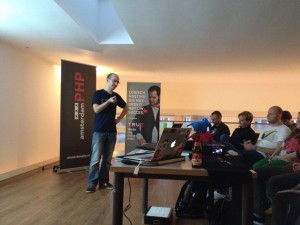
Yesterday I presented “Principles of PHP Package Design” at the monthly meetup of the AmsterdamPHP usergroup. This was quite an experimental presentation. I had prepared it on the same day actually, though I had been gathering the contents of it for several weeks.
Package design is a subject I’m very much interested in and you can be sure to hear more from me about it. Actually, I started writing a book about it! If you’re interested too, sign up on leanpub.com/principles-of-php-package-design.
Official book presentation: A Year With Symfony
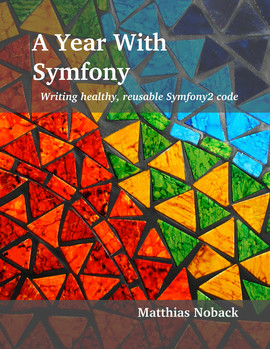
After working on my book “A Year With Symfony” for four months, I published it yesterday at the Dutch Symfony Usergroup meetup in Amsterdam. It was really great to be able to do this real-time while everybody in the room was looking at the screen waiting for the build process to finish.
The book is hosted on Leanpub, which is a great platform for writing and publishing books. They provide the entire infrastructure. You get a good-looking landing page and they handle all things related to payment.
Slides for my "Dependency Injection Smells" talk
Below you will find the slides for my presentation about Dependency Injection Smells (see also one of my previous posts from which this idea originated). If you have any questions, or feedback, please let me know by posting a comment below (or on joind.in).
Dependency Injection Smells - Speaking at the Dutch PHP Conference
This week is Dutch PHP Conference week! It is something I’m very excited about. Three years ago I attended this conference for the first time. It was also my first time to visit any (PHP) conference at all, and this is a big conference, with lots of speakers, lots of attendees and multiple tracks. The Dutch PHP Conference (DPC) has a certain grandeur - many large rooms, many famous developers speaking. It is an inspiring event. Visiting the conference back in 2010 lit a fire in me to start investigating anything there was to know about writing good code: reusable, clean code, with well named, short and testable methods, readable and maintainable by others. In other words, I started being critical of the code I produced.